
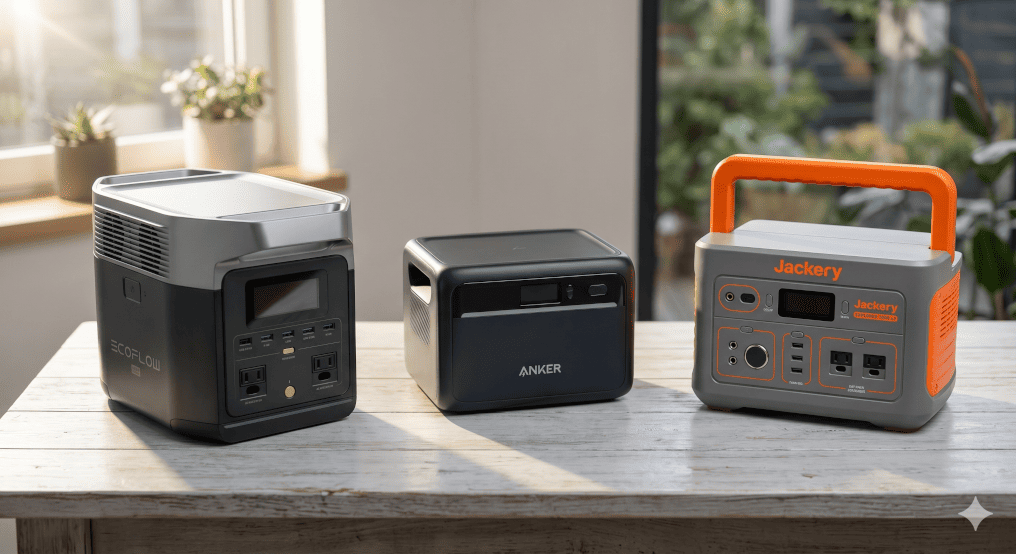
In portable power stations, the 1000-watt category is recognized as the sweet spot. It has enough power to run most critical home appliances during blackouts, like CPAP machines, and full size refrigerators. At the same time, it’s light enough to throw in the car for a weekend camping trip. However, by 2026 for the maturing market, having ‘1000 watts’ will be insufficient for a power station. Users will expect fast charging, long-lasting batteries, and integrated smart apps.
This guide will look at the top 10 1000-watt power stations for the 2026 market in order to provide enough data for the efficiency, charging time, and durability, so you can choose the right one for your emergancy kit, or your gear closet. Your power stations with the ‘Goldilocks’ power will be ready.
The Big Three: Reviews for 1000 Watt Power Stations in 2026
The market is currently dominated by three major players in the 1000-watt power stations, and is taking a different approach as to what the ideal 1000-watt power station for your needs is.
1. The Performance Leader: EcoFlow Delta 3 Plus
The EcoFlow Delta 3 Plus (an evolution of the popular Delta 2) is currently the most recognized and lightweight in speed and versatility.
• The Tech: It has a 1024Wh Lithium Iron Phosphate Battery and 1800W AC output (surge 3000W+).
• The Review: For years, it has consistently been rated the “Fastest Recharging” unit. In the real world, it has been documented to reach 80% charge in ~ 40 minutes. Full charge takes ~ 56 minutes.
• Pros: Great app control, expandable batteries, and 10ms UPS.
• Cons: The cooling fans are a bit loud when charging “X-stream” fast.
2. The Efficiency King: Anker Solix C1000 (Gen 2)
Anker has fast become a favorite for build quality and “usable” capacity vs. marketing numbers.
- The Tech: 1024Wh capacity and enormous 2000W continuous AC output.
- The Review: While most units lose 20% of their energy to internal heat (inverter tax), the C1000 Gen 2 manages to capture an industry leading 85-87% efficiency.
- Pros: Extremely compact “flat-top” design for easy stacking, ultra-durable LiFePO4 cells rated for 10+ years of service, and a very sensible physical interface.
- Cons: The Gen 2 C1000 has omitted the expansion battery port to save weight, unlike the EcoFlow.
3. Most Simple to Use: Jackery Explorer 1000 v2
As the creator of this category, Jackery has revamped their Explorer 1000 v2 with modern LiFePO4 batteries.
* The Tech. 1070Wh battery with a 1500W AC output.
* The Review. This unit is considered the “simplest to operate.” The competitor models have a lot of complex menus, but Jackery’s v2 has large, easy-to-see buttons – and a “plug and play” approach.
* Pros. Very quiet operation, foldable handle is high quality and the unit is 200W solar panel compatible to an excellent degree.
* Cons. Solar charging speeds are slower to some degree than rival brands EcoFlow and Anker.
Technical Comparison Table
The highest reviewed models have been written about countless times. This is a recent visualization of comparisons.
| Feature | EcoFlow Delta 3 Plus | Anker Solix C1000 G2 | Jackery Explorer 1000 v2 |
| Capacity | 1024 Wh | 1024 Wh | 1070 Wh |
| AC Output | 1800W (2200W Boost) | 2000W | 1500W |
| Charge Time | ~56 Minutes | ~49 Minutes | ~1 Hour |
| Weight | 27.5 lbs | 24.9 lbs | 23.8 lbs |
| UPS Speed | 10ms | 10ms | 20ms |
| Lifespan | 4,000 Cycles | 4,000 Cycles | 4,000 Cycles |
Why LiFePO4 Battery Chemistry is a Game Changer
If you reviewed 1000 watt power stations from 3-4 years ago, you will read a lot about “NMC” batteries”. Today they are regarded as obsolete tech for large power stations.
Starting in 2026, all top-tier units will be incorporating LiFePO4 (Lithium Iron Phosphate) batteries. This change is essential for two main reasons:
1. Lifespan: NMC batteries have a life expectancy of roughly 500 charging cycles before there is a noticeable drop in capacity. In comparison, LiFePO4 batteries have a lifetime of roughly 3,000 to 4,000 cycles. This means that a unit can last 2 years or as long as 10 years based on the type of battery used.
2. The safety factor: LiFePO4 batteries run cooler than the competition and therefore pose a significantly lower risk of starting a fire due to battery punctures or even extreme heat as found in Arizona or Texas.
What Can 1000 Watts Actually Do?
1000 Watts can seem like an unusual and abstract figure to think about. Based on a variety of testing, and the multitude of reviews testing a 1000 watt power station, here is a summary of what can be expected to be powered:
For Home Emergencies:
– Full-sized Fridge (150W-200W) 6 to 10 hours. (Note- A fridge does not constantly run, and cycles run on and off. Hence, a 1000Wh fridge can keep food safe for 18 to 24 hours).
– CPAP MACHINE (30W-60W) 2 to 3 full nights.
– Wi-Fi router & modem (20W) 40+ hours.
For Off Grid:
– Portable 12V Fridge (40W) 20 to 30 hours.
– Electric Kettle (1200W) 10 to 12 full boils.
– Laptop charger (60W) 12 to 15 full charges.
Considerations Beyond Wattage
Price isn’t the only factor to consider when looking at 1000 watt power stations. Consider the following to ensure you will be satisfied long-term:
1. Port Variety: If you want to charge laptops quickly, you will want to look for more than one USB-C PD port, especially for laptops. Anker and EcoFlow already have 100W or 140W USB-C ports, whereas, for some of the more budget brands, they stop at 60W.
2. Solar Input: If you want to go off the grid for a week, look for input units that are 400W. This will allow you to fully recharge the unit for 3-4 hours of sunlight.
3. UPS: If you’re planning to use the station for your desktop computer or home server, look for one that advertises “10ms” as a switchover time. Anything over that (20ms or 30ms, for example) is slow enough to cause restart the computer before the battery is initiated.
4. Noise Level. Some models are very loud. Some models charge and operate at very high loads and sound like a jet engine. If you plan to operate the unit in a small van or tent, look for reviews mentioning “Silent Mode” or “Quiet Charging”.
FAQ
Q1. Is 1000W enough to run a coffee maker?
Most standard drip coffee makers and espresso machines pull between 900W and 1500W. Therefore, a 1000Wh power station with a 1800W inverter (like the EcoFlow or Anker) will handle it with ease. A small 500W station, however, would not be able to do so.
Q2. Can I leave a 1000W power station plugged in all the time?
Most modern units have a bypass mode. This means that they will allow the wall power to be used directly by whatever devices are plugged in, only using the battery if the power goes out. This also helps to prolong the battery’s lifespan.
Q3. How heavy is a 1000 watt power station?
You should expect the weight to be between 24 and 30 pounds. This is about the same as carrying a medium-sized dog, or two big shopping bags.
Question 4: Do these units lose charge if I don’t use them?
LiFePO4 batteries are good for storage, only losing 2-3% of their charge per month. For better longevity of the battery, however, you should check and charge them every 3-6 months.
Final Verdict: Which 1000W Station is the Best?
After compiling hundreds of reviews of 1000 watt stations, the conclusion is based on what you want to prioritize most:
• For the Technician and Emergency Prep: EcoFlow Delta 3 Plus wins. It has ridiculous charging speed and has smart features.
• For the Camper and Minimalist: Anker Solix C1000 has the optimal ratio of size to weight to efficiency.
• For the Traditionalist: Jackery Explorer 1000 v2 delivers the simplest, most durable experience without the learning curve.
Final Check: Before you buy, check what your most “power-hungry” device is. Does it need more than 1500W to start up? In that case, you will need to buy a power station that has a “Surge” or “Boost” rating that is high enough to accommodate the initial pull!